
Engineering the Lifelines of Global Energy Infrastructure
The modern world operates on a 24/7 basis, driven by an insatiable demand for energy. The systems that connect power generation sources to final consumption points—whether a sprawling metropolis, a critical data center, or a heavy industrial plant—are not just infrastructure; they are the lifelines of economic stability and progress.
Our Power Distribution and Transmission portfolio is designed to address the complex challenges of today’s evolving energy landscape. Today’s grids face unprecedented pressures: aging legacy infrastructure, exponentially increasing loads, the need for higher efficiency to reduce technical losses, and the complex integration of variable renewable energy sources like wind and solar.
We provide the critical hardware essential for building resilient, high-capacity networks capable of meeting these demands. Our solutions bridge the gap between gigawatt-scale generation and end-user utilization with absolute reliability.
Our Commitment to Grid Resilience & Efficiency. This category encompasses the entire spectrum of the power delivery chain. We focus on delivering components that ensure
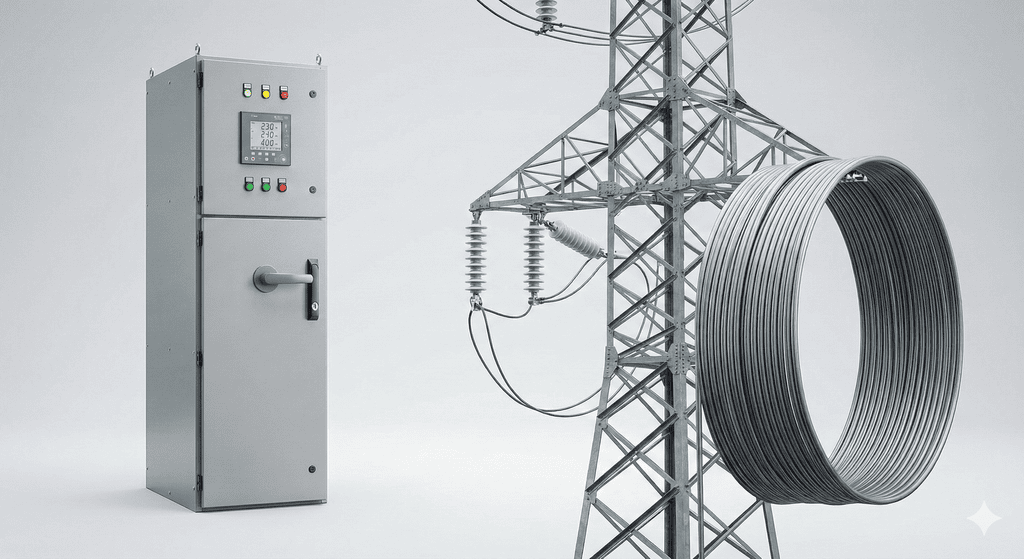
Minimized Transmission Losses: Utilizing advanced materials and engineering in our EHV and HV cables to ensure maximum power reaches its destination over long distances.
Operational Continuity: Providing robust transformers and switchgear engineered to withstand extreme electrical, thermal, and environmental stresses, ensuring uptime in critical applications.
Safety and Compliance: Every product in this category is manufactured to rigorous international standards (such as IEC, IEEE, and ANSI) to ensure the highest levels of safety for personnel and protection for valuable assets.
Future-Ready Infrastructure: Solutions designed to handle the increasing power densities required by modern industry and urbanization.
From the ultra-high voltage cables spanning nations to the precise busbar systems powering a factory floor, our products are the backbone of reliable energy.
Extra High Voltage (EHV) Cables (66kV to 400kV)

High-Capacity Transmission for National Grids and Major Utility Networks
Extra High Voltage (EHV) cables are the critical arteries of modern power infrastructure, designed to transmit massive amounts of electrical power over long distances with minimal losses. Engineered for voltages ranging from $66kV$ up to $400kV$, these cables are essential for connecting power plants to primary distribution grids and interconnecting national networks. Our EHV cables are manufactured utilizing advanced materials and cutting-edge technology to ensure operational longevity and dielectric integrity under immense electrical stress.
Key Features & Benefits:
Advanced Insulation Technology: Utilizes high-grade Cross-Linked Polyethylene (XLPE) insulation with ultra-smooth semi-conductive screens to ensure superior dielectric strength and prevent partial discharges.
Minimized Transmission Loss: Large conductor cross-sections (copper or aluminum) and optimized designs significantly reduce $I^2R$ losses, ensuring maximum energy efficiency over long hauls.
Robust Metallic Sheathing: Features lead alloy or corrugated aluminum sheathing to provide an impermeable radial water barrier and robust mechanical protection, essential for underground and subsea applications.
High Thermal Performance: Designed to operate continuously at high conductor temperatures (typically up to $90^\circ\text{C}$), allowing for higher current carrying capacity.
Typical Applications:
National and regional power transmission grids.
Connecting large-scale renewable energy farms (wind/solar) to the grid.
Interconnections between power plants and primary substations.
Underground transmission in densely populated urban areas where overhead lines are not feasible.
High Voltage (HV) Cables

Reliable Power Delivery for Urban Networks and Heavy Industry
Bridging the gap between long-distance transmission and local distribution, our High Voltage (HV) cables are the preferred choice for regional utility networks and large-scale industrial complexes. Typically covering voltages just below the EHV threshold down to primary distribution levels (e.g., $11kV$ to $33kV$, and sometimes up to $66kV$ depending on definitions), these cables balance high power capacity with the flexibility needed for complex installations. They are engineered for reliability in demanding environments, ensuring uninterrupted power supply to critical sectors.
Key Features & Benefits:
Durable Construction: Features robust outer jacketing (PVC or PE) resistant to abrasion, chemicals, and environmental factors, suitable for direct burial or duct installations.
Reliable Insulation: High-quality XLPE insulation ensures long service life and resistance to electrical treeing.
Effective Shielding: Copper wire or tape screens manage electrical field stress and provide a path for fault currents, enhancing safety.
Flexibility in Installation: Designed for relatively easier handling during installation in varied terrains compared to EHV counterparts.
Typical Applications:
Primary distribution networks in urban and suburban areas.
Power supply to heavy industries such as steel plants, refineries, and mining operations.
Feeder connections for large commercial complexes and data centers.
Infrastructure projects like railways and metros.
Power Transformers (Oil-cooled & Dry-type)

Critical Voltage Transformation for Efficient Grid Operations
Power transformers are the indispensable nodes in any electrical network, responsible for stepping up voltage for efficient transmission and stepping it down for safe utilization. We offer a comprehensive range of both Oil-cooled and Dry-type (Cast Resin) transformers designed for high efficiency, mechanical strength, and thermal stability. Whether for outdoor substation applications or indoor industrial setups requiring high fire safety, our transformers ensure optimal voltage regulation and seamless power flow.
Oil-cooled Transformers
Best for: High-capacity outdoor substations and long-distance transmission.
Features: Uses mineral oil or ester fluids for excellent insulation and heat dissipation through radiator fins.
Benefits: Capable of handling very high KVA/MVA ratings, robust design for outdoor environments, and proven long-term reliability.
Dry-type (Cast Resin) Transformers
Best for: Indoor installations, commercial buildings, and areas requiring high fire safety.
Features: Windings are encapsulated in epoxy resin, eliminating the need for flammable cooling oil.
Benefits: Self-extinguishing and fire-resistant, low maintenance (no oil checks), environmentally friendly, and compact footprint.
Typical Applications:
Transmission and distribution substations (Oil-cooled).
Industrial plants, high-rise buildings, hospitals, and underground installations (Dry-type).
Industrial Switchgears & Busbars
The Control Center for Industrial Power Safety and Distribution
Safe and organized power distribution within an industrial facility is non-negotiable. Our range of Industrial Switchgears and Busbar trunking systems provides the necessary protection, control, and efficient distribution of electrical power. Switchgear ensures the safety of personnel and equipment by isolating faults, while busbars offer a compact, high-efficiency alternative to traditional cabling for distributing heavy currents within panels and across facility floors.
Key Features & Benefits:
Industrial Switchgear (MV & LV):
Robust Protection: Includes high-performance circuit breakers (ACB, MCCB, VCB) and fuses to protect against overloads and short circuits, minimizing downtime.
Modular Design: Allows for easy scalability and maintenance of power distribution panels.
Enhanced Safety: Features interlocks, arc-flash protection mechanisms, and safe isolation protocols for operator safety.
Busbar Trunking Systems (BBT):
High Conductivity: Utilizes high-purity electrolytic copper or aluminum conductors for efficient power transfer with minimal voltage drop.
Space Saving: Compact design replaces multiple runs of heavy cables, freeing up valuable floor and overhead space.
Flexible Power Tapping: Plug-in boxes allow for easy addition or relocation of loads without shutting down the entire system.
Typical Applications:
Main Power Distribution Panels (PCC) and Motor Control Centers (MCC) in factories.
Power distribution in data centers, commercial towers, and hospitals.
Critical infrastructure requiring high fault level protection.
